
Digital Posture Analysis vs Static Postural Assessment: The Clinical Shift
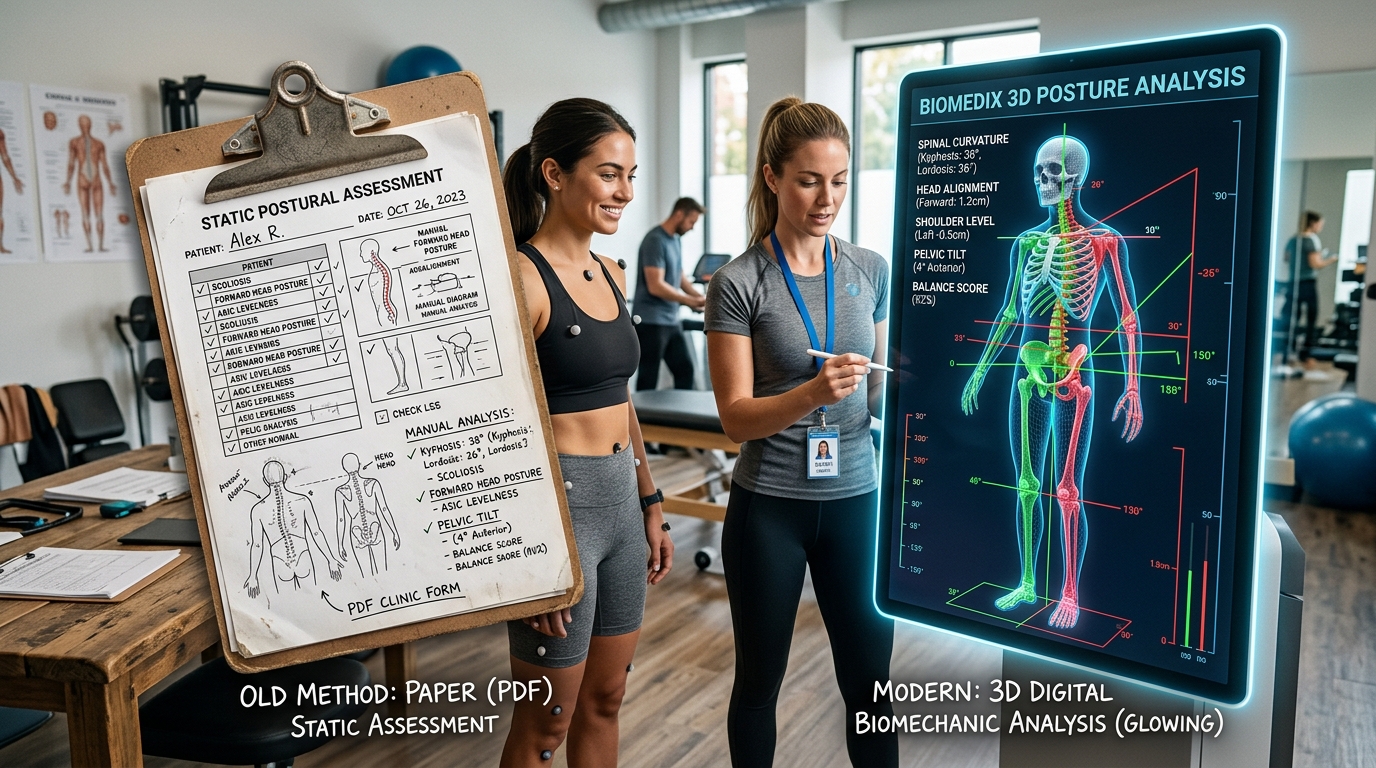
For decades, a plumb line, a grid chart on the wall, and a printed postural assessment pdf were the gold standard in physiotherapy clinics. Today, digital analysis is rendering these manual, subjective methods obsolete.
What is Digital Posture Analysis and Does it Work Austin?
From tech hubs like Austin, Texas to leading rehabilitation hospitals globally, professionals are asking: what is digital posture analysis and does it work austin? The answer is a resounding yes. It completely replaces the subjective nature of a static postural assessment with objective, reproducible, and mathematically sound data.
In a traditional static postural assessment, a clinician relies on their naked eye to estimate degrees of deviation. This method has famously low inter-rater reliability. Digital analysis uses AI and 3D sensors to capture the exact coordinates of the body in space, removing human error entirely.
Abandoning the Posture Assessment PDF
Using a printed posture assessment pdf or a postural analysis pdf requires time-consuming manual data entry. Furthermore, performing a lateral view posture analysis and an anterior posture analysis by eye is incredibly difficult when dealing with subtle, millimeter-level asymmetries.
Consider the process of evaluating forward head posture during a lateral view posture analysis. On a postural analysis pdf, a clinician might check a box labeled "mild" or "severe." With a digital system, the clinician receives an exact measurement: "Cervical Lordosis Deviation: 14.2 degrees anterior." This level of precision is impossible with paper forms.
The Transition to Paperless, Objective Clinics
By moving away from the posture assessment pdf, clinics not only save hours of administrative time but also generate professional, branded reports that can be instantly emailed to patients or referring physicians.
Clinical Upgrade
Digital systems standardize the entire diagnostic process. Dive deeper into the clinical protocols by reviewing our modern, digital Postural Assessment Guide, and see why paper is a thing of the past.
Why the Postural Analysis PDF is Failing Your Patients
Imagine a patient returning for their 6-week follow-up. Using a postural analysis pdf, you pull out a paper file and try to visually compare today's stance to your hand-drawn notes from six weeks ago. Did their lateral view posture analysis improve by 2 degrees? It is impossible to tell. The static postural assessment on paper is inherently stagnant.
Now, ask the question again: what is digital posture analysis and does it work austin practitioners might ask? Digital analysis works because it is comparative. When a patient steps onto a digital platform, the software instantly overlays their current 3D scan with their baseline scan. It highlights changes in green (improvement) or red (regression) down to the millimeter. This visual, objective proof is what drives patient compliance. Abandoning the posture assessment pdf is not just about saving paper; it is about providing a higher standard of evidence-based care.
Frequently Asked Questions (Digital vs Static)
Why is lateral view posture analysis critical?
Are postural assessment pdf forms still useful?
What is Digital Posture Analysis and Does It Work?
A frequently asked question in modern orthopedic circles is: What is digital posture analysis and does it work accurately compared to traditional methods?
Digital posture analysis is the process of using artificial intelligence (AI), computer vision, and optical sensors to automatically detect, measure, and report on human skeletal alignment. Yes, it works exceptionally well. Clinical studies demonstrate that an automated posture analysis system eliminates the subjective human error found in a traditional static postural assessment.
While old methods required a clinician to manually draw lines on a printed postural assessment pdf using a plumb line, modern digital chiropractic posture analysis instantly measures cervical angles, shoulder symmetry, and pelvic tilt in real-time. This ai posture detection not only works but drastically accelerates the diagnostic workflow, transforming an arduous 20-minute manual evaluation into a flawless 30-second digital scan.